
Let the print file be vectorized.
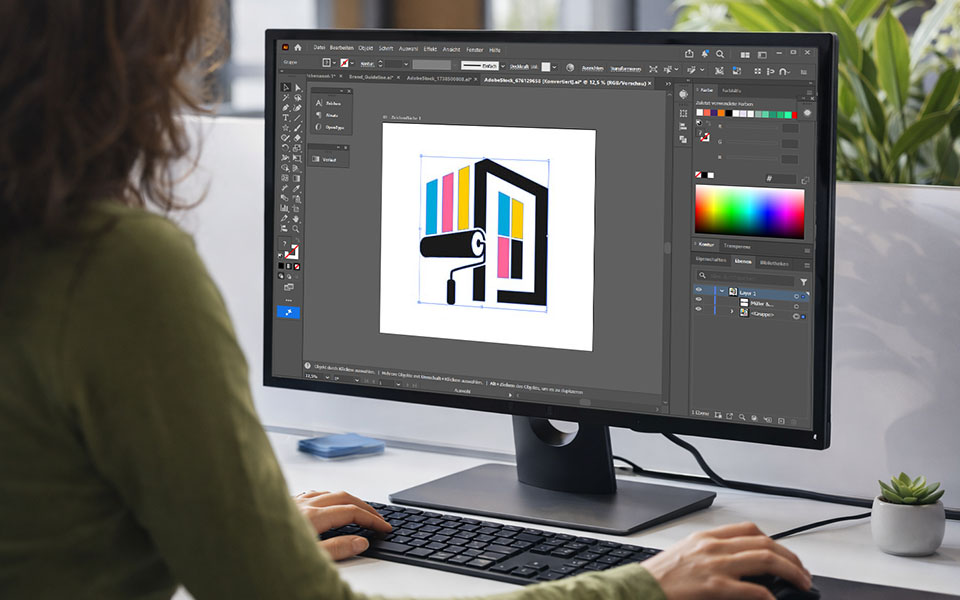
Why is vectorization useful?
A good print file is an important prerequisite for a clean printing result. If your motif is not available in suitable quality or is only present as a simple pixel graphic, vectorization can be useful. This is especially true if the motif is to be implemented in screen printing or if clear contours and clean color areas are important.
With a vectorized file, motifs can be processed more technically precisely. This creates better conditions for a clean printing implementation and makes it easier, especially in screen printing, to prepare the print data.
What is the difference between pixel graphics and vector graphics?
Pixel graphics consist of many individual image points. This includes files such as .jpg, .png, or .psd. These files always have a fixed resolution. When they are enlarged, they lose quality and quickly appear blurry or pixelated.
For textile printing, this can lead to problems:
- Contours appear unclean or blurred
- Fine details are lost
- Colors are often harder to separate in screen printing
- The file may not be optimal for print preparation
Vector graphics work differently. They do not consist of individual pixels, but rather of lines, curves, and shapes. This allows them to be scaled without loss of quality. Contours remain clear, areas clean, and the file can be processed more flexibly for printing.
Especially for logos, inscriptions, graphic motifs, and clear color areas, a vector file is usually the better basis.
When is vectorization advisable?
Vectorization is particularly useful when:
- Your motif is only available as a small or blurry pixel graphic
- A logo, inscription, or graphic illustration is to be printed
- The motif is to be implemented in screen printing
- Colors need to be clearly separated
- A better technical basis for printing is required
Scans, drawings, or hand-drawn motifs can often also be vectorized and thus prepared for printing.
How does vectorization work?
In vectorization, an existing raster or pixel graphic is converted into a vector graphic. The visible shapes and contours of the motif are digitally reconstructed so that they no longer consist of individual pixels but of scalable paths and areas.
The result is a file that can be enlarged or further processed without loss of quality. This allows the motif to be prepared more cleanly for printing and implemented better depending on the application.
Important to know: Vectorization does not automatically improve every motif without limits. The quality of the original template always remains crucial. The cleaner and clearer the original file is, the better the motif can be transformed into a high-quality vector file.
How do I order the vector service?
If you need vectorization, you can send us your print file in advance for review via email to info@prinovia.com. Alternatively, you can also indicate in the comments field when completing the order that vectorization is desired.
If you want to receive the finished vector file after processing, you should also specify this directly.
What does the vector service cost?
In connection with a textile printing order at Prinovia, vectorization costs a flat rate of 35 € gross per motif.
The billing is not based on hours, but at a fixed flat rate. Subsequent changes to the created vector file are not included and will be charged separately for additional processing effort.
The most important points at a glance
- Vectorization improves the technical basis for printing
- It is particularly useful for logos, inscriptions, and graphic motifs
- For screen printing, a vector file is often particularly advantageous
- Pixel graphics lose quality when scaled, vector graphics do not
- The vector service costs 35 € gross per motif in connection with a printing order
This way, an unsuitable or not optimal template can often be turned into a significantly better print-ready file.